
Anopheles species-vectors for filarial parasites
Anopheles Mosquito Vectors of Human Lymphatic Filariasis: Distribution of Wuchereria bancrofti Across Endemic Zones
Lymphatic filariasis is a mosquito-borne parasitic disease caused by filarial nematodes that affect the lymphatic system. Among the parasites responsible for this infection, Wuchereria bancrofti is a major causative agent of human lymphatic filariasis and is transmitted through the bites of infected mosquitoes.

Mosquitoes belonging to the genus Anopheles play an important role in the transmission of Wuchereria bancrofti in several geographical regions. Their involvement in parasite transmission varies according to geographical distribution, environmental conditions, mosquito population dynamics, and interactions between the parasite and its vector.
Understanding the distribution of mosquito vectors across endemic zones is essential for studying the epidemiology of lymphatic filariasis, identifying potential transmission areas, and supporting vector surveillance and disease control programs.
This article presents the Anopheles-transmitted filarial parasites of humans and their associated mosquito vectors across selected endemic zones, with particular attention to Wuchereria bancrofti and its nocturnal periodic form.
1. Biological and Epidemiological Background of Wuchereria bancrofti
Wuchereria bancrofti is a filarial nematode responsible for the majority of lymphatic filariasis cases worldwide. The parasite is transmitted to humans through the bites of infected female mosquitoes, which act as biological vectors during its development and transmission cycle.

Following the introduction of infective larvae into the human host, the parasites migrate into the lymphatic system, where they mature into adult worms. These adult parasites can persist for several years and may contribute to lymphatic dysfunction and chronic inflammatory complications.
The clinical manifestations of lymphatic filariasis vary considerably. Some infected individuals remain asymptomatic, while others develop lymphatic abnormalities, lymphedema, hydrocele, and other long-term complications.
1.1 Nocturnal Periodicity
The form of Wuchereria bancrofti presented in this list is characterized by nocturnal periodicity.
Nocturnal periodicity refers to a pattern in which circulating microfilariae are present in higher concentrations in peripheral blood during nighttime hours. This biological adaptation is associated with the feeding behavior of mosquito vectors and contributes to the transmission dynamics of the parasite.
This phenomenon is important in epidemiological investigations because the timing of blood collection can influence the detection of microfilariae in infected individuals.
2. The Role of Anopheles Mosquitoes in Filarial Transmission
Mosquitoes belonging to the genus Anopheles are widely recognized for their role in transmitting human pathogens, particularly malaria parasites. However, certain Anopheles species can also act as vectors of lymphatic filariasis.
Their involvement in the transmission of Wuchereria bancrofti depends on several biological and ecological factors, including:
-
Vector competence: The ability of a mosquito species to support the development of filarial parasites and transmit infective larvae.
-
Mosquito feeding behavior: The frequency and timing of blood-feeding activities influence contact with human hosts.
-
Geographical distribution: The presence of competent mosquito species determines potential transmission areas.
-
Environmental conditions: Temperature, humidity, rainfall, and breeding-site availability influence mosquito population dynamics.
-
Host-vector interactions: The frequency of contact between mosquitoes and infected individuals contributes to parasite circulation.
The identification of primary and subsidiary mosquito vectors is therefore important for understanding regional transmission patterns.
3. Endemic Zones and Associated Anopheles Vectors
The geographical distribution of Wuchereria bancrofti transmission is associated with different mosquito species across tropical and subtropical regions. The following classification presents the endemic zones and their associated Anopheles vectors.
The list distinguishes main (primary) vectors from subsidiary vectors. Primary vectors are indicated in bold type, while subsidiary, incidental, and local vectors are presented in regular type.
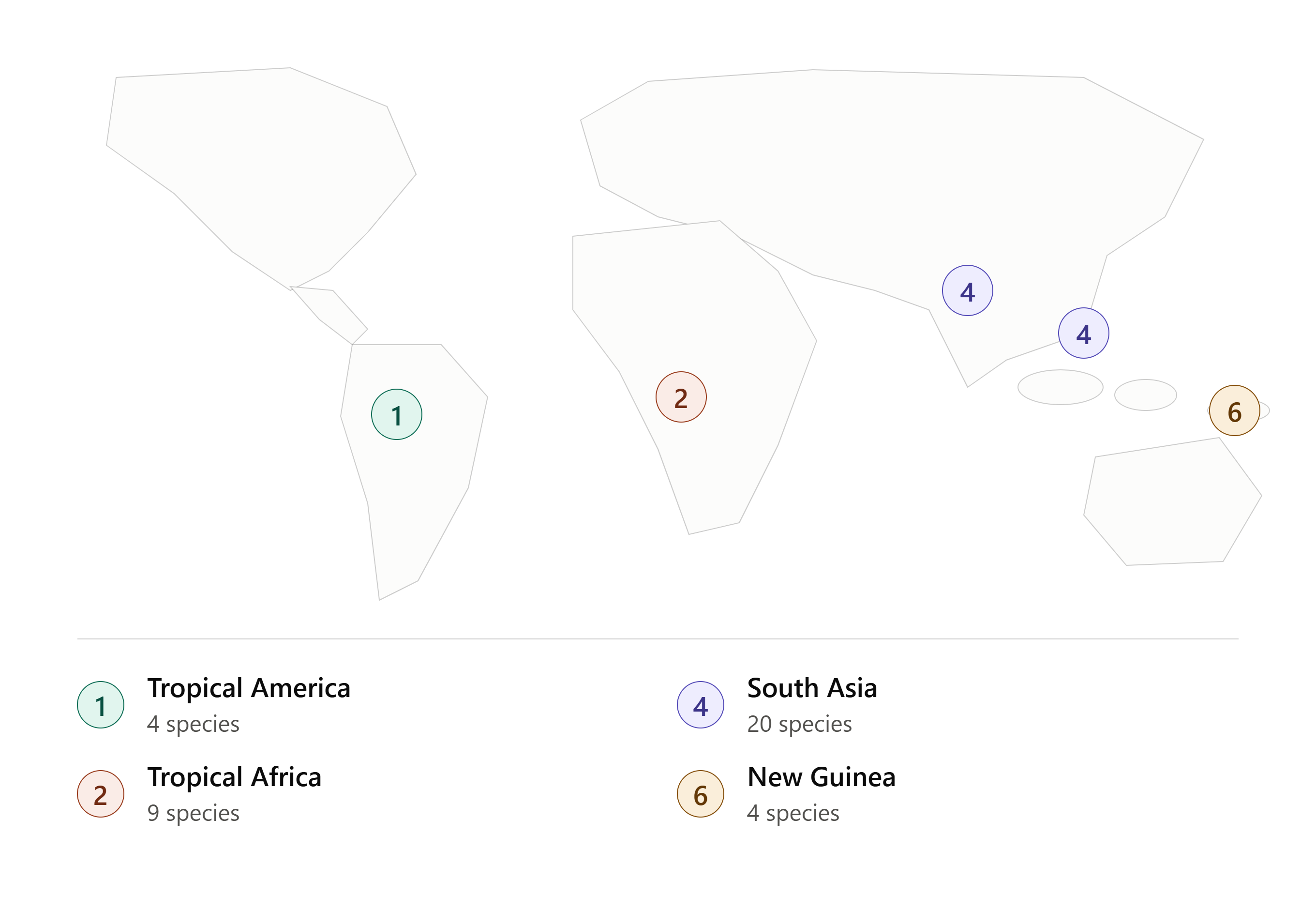
Endemic Zones and Associated Anopheles Vectors
The geographical distribution of Wuchereria bancrofti transmission is associated with different mosquito species across tropical and subtropical regions. The following classification presents the endemic zones and their associated Anopheles vectors.
The list distinguishes main (primary) vectors from subsidiary vectors. Primary vectors are indicated in bold type, while subsidiary, incidental, and local vectors are presented in regular type.
3.1 Zone 1: Tropical America
Tropical America includes geographical environments characterized by diverse climatic conditions, extensive tropical vegetation, and ecological systems that can support mosquito populations.
Several Anopheles species are associated with the transmission of Wuchereria bancrofti in this region. Their distribution is influenced by local environmental conditions and the availability of suitable aquatic breeding habitats.
The listed species include Anopheles (K.) bellator, Anopheles (N.) albimanus, Anopheles (N.) aquasalis, and Anopheles (N.) darlingi. The latter is identified as a primary vector in the supplied classification.
3.2 Zone 2: Tropical Africa
Tropical Africa represents an important geographical region for the study of mosquito-borne filarial transmission.
The region supports several mosquito species belonging to the subgenus Cellia, with different ecological preferences and geographical distributions.
The listed vectors include Anopheles (C.) arabiensis, Anopheles (C.) funestus, Anopheles (C.) gambiae, Anopheles (C.) hancocki, Anopheles (C.) melas, Anopheles (C.) merus, Anopheles (C.) nili, Anopheles (C.) pauliani, and Anopheles (C.) wellcomei.
The diversity of these species highlights the importance of understanding local mosquito ecology when investigating the transmission of lymphatic filariasis.
3.3 Zone 4: South Asia
South Asia includes a wide range of ecological environments, from humid tropical areas to agricultural landscapes and densely populated regions.
The mosquito species associated with Wuchereria bancrofti in this zone belong to the subgenera Anopheles and Cellia.
The diversity of the listed species illustrates the geographical and ecological complexity of filarial transmission in this region. Differences in mosquito distribution, host-feeding behavior, and environmental conditions may influence the relative contribution of individual vector species.
3.4 Zone 6: New Guinea
New Guinea represents another important geographical area in the supplied classification.
The listed mosquito species include representatives of the subgenera Anopheles and Cellia. Their presence reflects the diversity of mosquito populations associated with tropical island environments.
The identification of these species contributes to the historical understanding of regional filarial transmission and provides a framework for examining vector distribution in the wider Pacific region.
4. Complete List of Anopheles Vectors of Wuchereria bancrofti
The following table reproduces the supplied classification, including the original species names, subgenus abbreviations, geographical zones, and distinction between primary and subsidiary vectors.
Wuchereria bancrofti (nocturnal periodic)
|
Endemic zone |
Anopheles species |
|---|---|
|
Zone 1 – Tropical America |
Anopheles (K.) bellator |
|
Anopheles (N.) albimanus |
|
|
Anopheles (N.) aquasalis |
|
|
Anopheles (N.) darlingi |
|
|
Zone 2 – Tropical Africa |
Anopheles (C.) arabiensis |
|
Anopheles (C.) funestus |
|
|
Anopheles (C.) gambiae |
|
|
Anopheles (C.) hancocki |
|
|
Anopheles (C.) melas |
|
|
Anopheles (C.) merus |
|
|
Anopheles (C.) nili |
|
|
Anopheles (C.) pauliani |
|
|
Anopheles (C.) wellcomei |
|
|
Zone 4 – South Asia |
Anopheles (A.) barbirostris |
|
Anopheles (A.) donaldi |
|
|
Anopheles (A.) kweiyangensis |
|
|
Anopheles (A.) letifer |
|
|
Anopheles (A.) nigerrimus |
|
|
Anopheles (A.) sinensis |
|
|
Anopheles (A.) whartoni |
|
|
Anopheles (C.) aconitus |
|
|
Anopheles (C.) antrhopophagus |
|
|
Anopheles (C.) balabacensis |
|
|
Anopheles (C.) dirus |
|
|
Anopheles (C.) flavirostris |
|
|
Anopheles (C.) jeyporiensis |
|
|
Anopheles (C.) leucosphyrus |
|
|
Anopheles (C.) maculatus |
|
|
Anopheles (C.) minimus |
|
|
Anopheles (C.) philippinensis |
|
|
Anopheles (C.) subpictus |
|
|
Anopheles (C.) tessellatus |
|
|
Anopheles (C.) vagus |
|
|
Zone 6 – New Guinea |
Anopheles (A.) bancroftii |
|
Anopheles (C.) farauti |
|
|
Anopheles (C.) koliensis |
|
|
Anopheles (C.) punctulatus |
5. Understanding the Anopheles Subgenera
The classification uses abbreviations to identify the subgenera to which the listed mosquito species belong.
These abbreviations are essential for interpreting the taxonomic organization of the table.
|
Abbreviation |
Subgenus |
|---|---|
|
A |
Anopheles sensu stricto |
|
C |
Cellia |
|
K |
Kerteszia |
|
N |
Nyssorhynchus |
Subgeneric classification provides a framework for organizing mosquito diversity and examining relationships between species. It is also useful in entomological research, vector identification, and comparative studies of mosquito biology.
Accurate species identification is particularly important in epidemiological surveillance because different mosquito species may exhibit different vector capacities, ecological preferences, and host-feeding behaviors.
6. Primary and Subsidiary Vectors: Epidemiological Significance
The distinction between primary and subsidiary vectors provides useful information about the relative importance of mosquito species in parasite transmission.
6.1 Primary Vectors
Primary vectors are mosquito species identified as major contributors to transmission in a given geographical area.
Their epidemiological importance may be associated with factors such as vector competence, abundance, human-biting frequency, and geographical distribution.
Identifying these species can help researchers understand the principal transmission pathways and develop targeted vector surveillance strategies.
6.2 Subsidiary, Incidental, and Local Vectors
Subsidiary vectors may contribute to transmission under particular ecological or geographical conditions.
Their involvement can be more localized or dependent on specific environmental circumstances. Although their contribution may differ from that of primary vectors, they remain relevant to understanding the complexity of parasite transmission.
The distinction between these categories is particularly important when interpreting historical vector classifications and comparing epidemiological observations across endemic regions.
7. Importance of Vector Identification in Lymphatic Filariasis Control
Accurate identification of mosquito vectors is a fundamental component of lymphatic filariasis surveillance and control.
Understanding which mosquito species are associated with parasite transmission can support several public health activities.
Entomological surveillance: Monitoring mosquito populations helps identify species present in endemic areas and evaluate changes in their geographical distribution.
Vector control strategies: Information about mosquito ecology and breeding habitats can support the selection of appropriate control interventions.
Epidemiological monitoring: Studying vector populations alongside human infection data helps characterize transmission patterns and identify areas requiring further investigation.
Research and taxonomy: Reliable species identification supports comparative studies of mosquito biology, vector competence, and parasite development.
Public health planning: Regional vector information can contribute to the design and evaluation of lymphatic filariasis prevention programs.
8. Historical Reference and Taxonomic Classification
The supplied classification is updated from the work of M. W. Service (1993), published in Medical Insects and Arachnids, edited by R. P. Lane and R. W. Crosskey, Chapman & Hall, London, pages 120–240.
Historical taxonomic classifications remain valuable resources for understanding the development of medical entomology and the documented associations between mosquito species and human parasites.
However, mosquito taxonomy, geographical distributions, and vector classifications may evolve as new molecular, ecological, and epidemiological evidence becomes available. Historical records should therefore be interpreted within their original scientific context and compared with current taxonomic and public health references when used in contemporary research.
Frequently Asked Questions (FAQ)
1. Which parasite causes lymphatic filariasis?
Wuchereria bancrofti is one of the major filarial nematodes responsible for lymphatic filariasis in humans.
2. Which mosquitoes transmit Wuchereria bancrofti?
Several mosquito genera can transmit Wuchereria bancrofti, including Anopheles. The species involved vary according to geographical region.
3. What does nocturnal periodicity mean?
Nocturnal periodicity describes the increased concentration of microfilariae in peripheral blood during nighttime hours.
4. What is the difference between primary and subsidiary vectors?
Primary vectors are identified as major contributors to parasite transmission, whereas subsidiary vectors may have incidental, localized, or secondary epidemiological roles.
5. What do the Anopheles subgenus abbreviations mean?
The abbreviations identify four subgenera: Anopheles sensu stricto (A), Cellia (C), Kerteszia (K), and Nyssorhynchus (N).
6. Why is mosquito vector identification important?
It supports entomological surveillance, epidemiological research, vector control planning, and the monitoring of lymphatic filariasis transmission.
Conclusion
This list shows the Anopheles-transmitted filarial parasites of man and their vectors in the endemic zones.
The table is updated from M.W. Service (1993) Mosquitoes (Culicidae) in: Medical Insects andA rachnids (R.P. Lane & R.W. Grosskey, eds.) Chapman & Hall, London, pp. 120-240. Abbreviations for subgenera given in parentheses are: A, Anopheles s.str.; C, Cellia; K, Kerteszia; N, Nyssorhynchus. Main (primary) vectors are distinguished from subsidiary (incidental and local) vectors by bold type.
Wuchereria bancrofti: (nocturnal periodic)
| Zone 1 *** Tropical America | Anopheles (K.) bellator |
| Anopheles (N.) albimanus | |
| Anopheles (N.) aquasalis | |
| Anopheles (N.) darlingi | |
| Zone 2 *** Tropical Africa | Anopheles (C.) arabiensis |
| Anopheles (C.) funestus | |
| Anopheles (C.) gambiae | |
| Anopheles (C.) hancocki | |
| Anopheles (C.) melas | |
| Anopheles (C.) merus | |
| Anopheles (C.) nili | |
| Anopheles (C.) pauliani | |
| Anopheles (C.) wellcomei | |
| Zone 4 *** South Asia | Anopheles (A.) barbirostris |
| Anopheles (A.) donaldi | |
| Anopheles (A.) kweiyangensis | |
| Anopheles (A.) letifer | |
| Anopheles (A.) nigerrimus | |
| Anopheles (A.) sinensis | |
| Anopheles (A.) whartoni | |
| Anopheles (C.) aconitus | |
| Anopheles (C.) antrhopophagus | |
| Anopheles (C.) balabacensis | |
| Anopheles (C.) dirus | |
| Anopheles (C.) flavirostris | |
| Anopheles (C.) jeyporiensis | |
| Anopheles (C.) leucosphyrus | |
| Anopheles (C.) maculatus | |
| Anopheles (C.) minimus | |
| Anopheles (C.) philippinensis | |
| Anopheles (C.) subpictus | |
| Anopheles (C.) tessellatus | |
| Anopheles (C.) vagus | |
| Zone 6 *** New Guinea | Anopheles (A.) bancroftii |
| Anopheles (C.) farauti | |
| Anopheles (C.) koliensis | |
| Anopheles (C.) punctulatus |