
"Molecular and Population Biology of Mosquitoes and Other Disease Vectors"
International Workshop on the Molecular and Population Biology of Arthropod Disease Vectors
The molecular and population biology of arthropod disease vectors is a multidisciplinary research field that brings together genomics, molecular genetics, ecology, evolutionary biology, and infectious disease research. Understanding the biological mechanisms governing vector development, genetic variation, population dynamics, and parasite transmission is essential for improving strategies aimed at controlling vector-borne diseases.
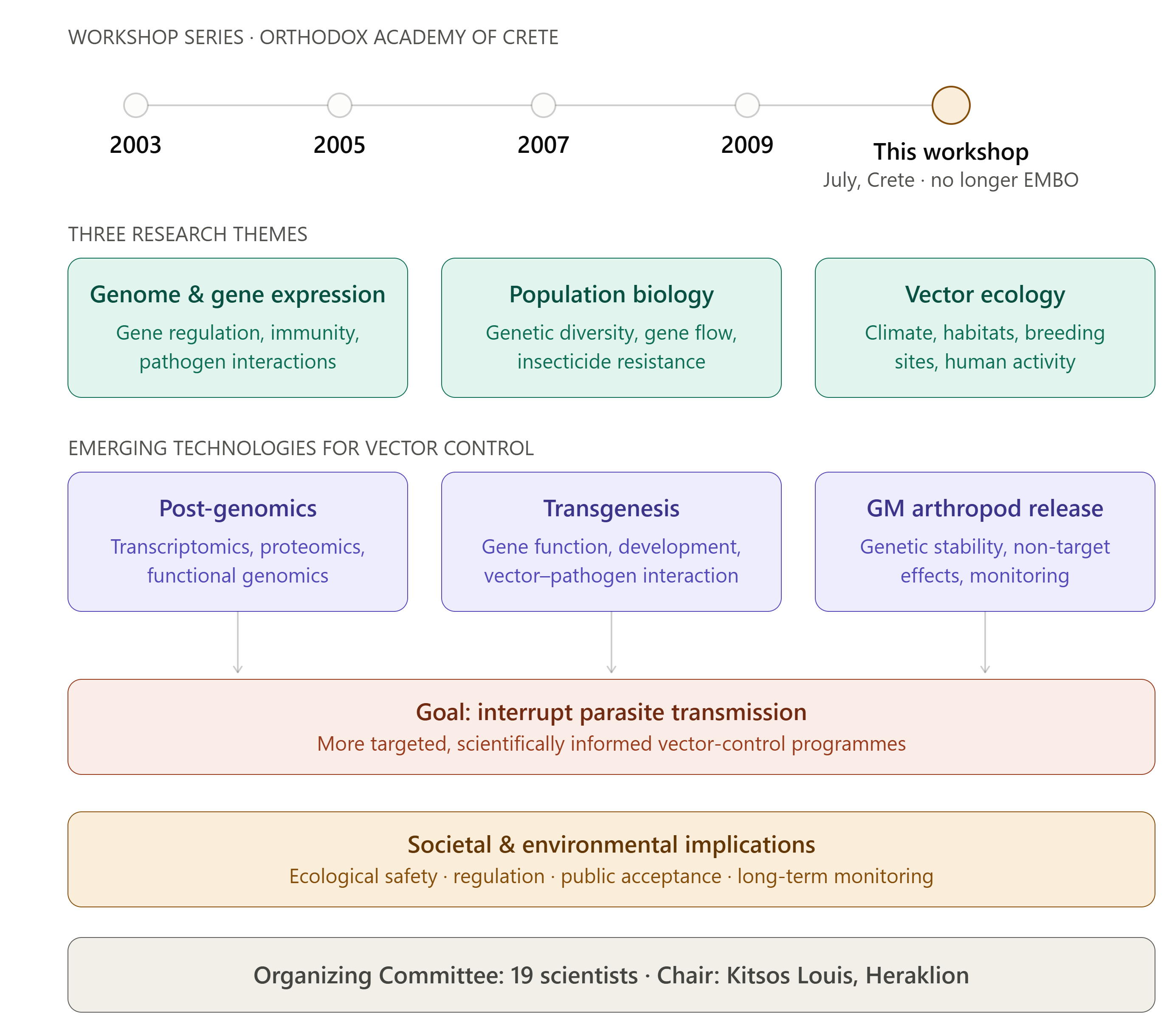
Building on a series of previous scientific meetings, this international workshop was designed to provide a platform for researchers to present their findings, exchange knowledge, and discuss emerging technologies for the control of arthropod disease vectors.
The meeting continued the scientific objectives of earlier workshops held at the Orthodox Academy of Crete, while expanding discussions to include post-genomics, transgenesis, genetically modified arthropods, and the potential societal implications of new vector-control approaches.
Organizing Committee
The workshop was supported by an international Organizing Committee bringing together scientists from several countries and research institutions. Their expertise covered mosquito biology, vector genetics, molecular parasitology, population ecology, and the development of innovative approaches to disease prevention.
Organizing Committee members:
-
Kitsos Louis, Heraklion (Chair)
-
Luna Kamau, Nairobi
-
Barry Beaty, Fort Collins
-
Nora Besansky, South Bend
-
Maureen Coetzee, Johannesburg
-
Frank Collins, South Bend
-
Didier Fontenille, Montpellier
-
Libor Grubhoffer, Ceske Budejovice
-
Janet Hemingway, Liverpool
-
Anthony A. James, Irvine
-
George Christophides, London
-
Pedro Oliveira, Rio de Janeiro
-
Jose Ribeiro, Bethesda
-
Humberto Lanz, Cuernavaca
-
Tom Scott, Davis
-
Bob Sinden, London
-
Ale della Torre, Rome
-
Yeya Toure, Geneva
-
Jake Tu, Blacksburg
For additional information, the original announcement provided the following contact address: louis[at]imbb.forth.gr.
Background and History of the Workshop Series
This meeting followed four previous workshops organized at the Orthodox Academy of Crete during the summers of 2003, 2005, 2007, and 2009.
These scientific gatherings established a recurring opportunity for researchers working on arthropod disease vectors to share experimental findings, discuss advances in molecular biology, and strengthen international scientific collaboration.
The continuation of this workshop series reflected the growing importance of integrating genomic information with population biology and ecological research. As molecular technologies advanced, researchers gained new opportunities to investigate vector biology at genetic, cellular, and population levels.
The subsequent meeting maintained the central objective of bringing together an international group of scientists to discuss current developments and emerging research directions.
Scientific Objectives and Research Themes
The main objective was to provide an international forum for presenting scientific findings on three closely related areas: genome organization and expression, population biology, and the ecology of arthropod disease vectors.
1. Genome Organization and Gene Expression
Genome organization and gene expression are fundamental aspects of understanding vector biology. Research in this area investigates the structure of genetic material, the regulation of genes, and the molecular mechanisms responsible for different biological processes.
Genomic studies can help identify genes involved in development, reproduction, environmental adaptation, immunity, and interactions with pathogens.
Gene-expression analysis also provides information about how arthropod vectors respond to environmental conditions, infection, and physiological changes.
2. Population Biology and Genetic Diversity
Population biology examines the distribution, structure, and dynamics of vector populations. Genetic variation between populations can influence their adaptation to different environments and their responses to control interventions.
Research on population structure and gene flow can help scientists understand:
-
Genetic differentiation between geographical populations.
-
Migration and dispersal patterns.
-
Population connectivity and evolutionary relationships.
-
The spread of insecticide-resistance traits.
-
Differences in vector competence and biological characteristics.
Combining population genetics with ecological information provides a more comprehensive understanding of the factors influencing disease transmission.
3. Ecology of Arthropod Disease Vectors
The ecology of arthropod vectors focuses on the relationships between vector species, their habitats, environmental conditions, and biological interactions.
Temperature, rainfall, vegetation, breeding-site availability, and human activities can influence vector abundance and distribution. Understanding these factors is essential for interpreting changes in vector populations and identifying conditions that may affect disease transmission.
Integrating ecological observations with molecular and genomic data can improve the interpretation of vector behaviour and population dynamics.
Emerging Technologies for Vector Control
One of the main subjects of discussion was the development of new tools and strategies for controlling disease transmission by targeting arthropod vectors.
The workshop highlighted several emerging research directions.
Post-Genomics Approaches
Post-genomics research uses genomic information to investigate biological functions, molecular interactions, and regulatory mechanisms. These approaches help researchers move beyond genome sequencing to understand how genes and proteins contribute to vector biology.
Transcriptomics, proteomics, and functional genomics can provide complementary information about molecular pathways involved in development, immunity, and pathogen interactions.
Transgenesis in Arthropod Vectors
Transgenesis involves introducing specific genetic modifications into an organism to investigate gene function or produce particular biological characteristics.
In arthropod research, transgenic technologies can be used to study development, reproduction, immunity, and interactions between vectors and pathogens.
These methods also contribute to investigations into potential genetic approaches for reducing vector populations or limiting their capacity to transmit infectious agents.
Release of Genetically Modified Arthropods
The potential release of genetically modified arthropods was another important topic identified in the workshop announcement.
Such strategies require careful consideration of genetic stability, ecological interactions, population dynamics, and possible effects on non-target organisms.
Their development also raises questions about environmental monitoring, regulatory frameworks, public acceptance, and long-term risk assessment.
Parasite Transmission and Public Health
A central theme of the workshop was the control of disease through interventions targeting parasite transmission.
Arthropod vectors can play a major role in the transmission cycles of numerous infectious agents. Understanding the interactions between vectors, parasites, and their environments is therefore essential for developing effective prevention strategies.
Molecular research can help identify factors involved in pathogen development within vectors, while population studies provide information about vector distribution and transmission potential.
Combining these approaches may contribute to more targeted and scientifically informed vector-control programmes.
Societal and Environmental Implications
The development of new vector-control technologies must be evaluated not only in terms of scientific effectiveness but also in relation to their broader societal impact.
Strategies involving transgenesis or the release of genetically modified arthropods require multidisciplinary assessment. Important considerations include ecological safety, public-health priorities, community engagement, regulatory oversight, and long-term monitoring.
The workshop therefore aimed to encourage discussion of the scientific and societal dimensions of emerging technologies, recognizing that successful disease-control strategies depend on both biological research and responsible implementation.
Organization and Conference Information
Unlike previous meetings associated with the EMBO Conference Series, this workshop was no longer being organized as part of that programme.
According to the original announcement, further information, including registration deadlines and other practical details, would be published on the workshop webpage later in the year.
Potential participants were encouraged to bookmark the announcement page and consult it regularly for updates.
Travel and Accommodation in Crete
The announcement emphasized that July is a high tourist season in Crete and throughout Greece. Accepted participants were therefore advised to arrange their travel as early as possible.
Researchers wishing to spend additional days on the island were advised that arranging an extended stay before the workshop might be more convenient than doing so afterward.
The organizers also indicated that accepted participants would receive additional information and assistance concerning travel to and from Crete.
Conclusion
The International Workshop on the Molecular and Population Biology of Arthropod Disease Vectors continued a series of scientific meetings established at the Orthodox Academy of Crete in 2003.
By bringing together international researchers, the meeting aimed to advance discussions on genome organization, gene expression, population biology, vector ecology, and emerging genetic technologies.
Its emphasis on post-genomics, transgenesis, genetically modified arthropods, and parasite transmission reflected the growing importance of interdisciplinary research in developing new approaches to vector control and disease prevention.