
SOME MALARIA INITIATIVES AND RESOURCES
Malaria Research and Reference Reagent Resource Center (MR4): Supporting Global Malaria Research
The Malaria Research and Reference Reagent Resource Center (MR4) was established to provide a central source of quality-controlled malaria-related reagents, research materials and scientific information to the international malaria research community.
Access to reliable biological materials and standardized research reagents is essential for advancing malaria research. Scientists working on malaria parasites, mosquito vectors, host–parasite interactions and disease transmission require well-characterized materials to conduct experiments, validate findings and develop new research approaches.
By bringing together a wide range of malaria-related resources, MR4 supports researchers in accessing materials needed for different areas of malaria investigation. Its role is particularly relevant to laboratories studying parasite biology, molecular mechanisms, vector biology, immunology and the development of new diagnostic or intervention strategies.

1. A Central Resource for the International Malaria Research Community
MR4 was created to facilitate access to specialized malaria research materials through a centralized resource. Its objective is to support scientific research by making quality-controlled reagents and relevant information available to the international malaria research community.
The availability of standardized materials is important for improving experimental consistency and supporting the reproducibility of scientific studies. Researchers working in different laboratories and geographical regions can use reference materials to investigate similar biological questions and compare experimental results.
These resources can contribute to research on several aspects of malaria, including parasite development, mosquito infection, molecular characterization, antigen identification and interactions between malaria parasites and their hosts.
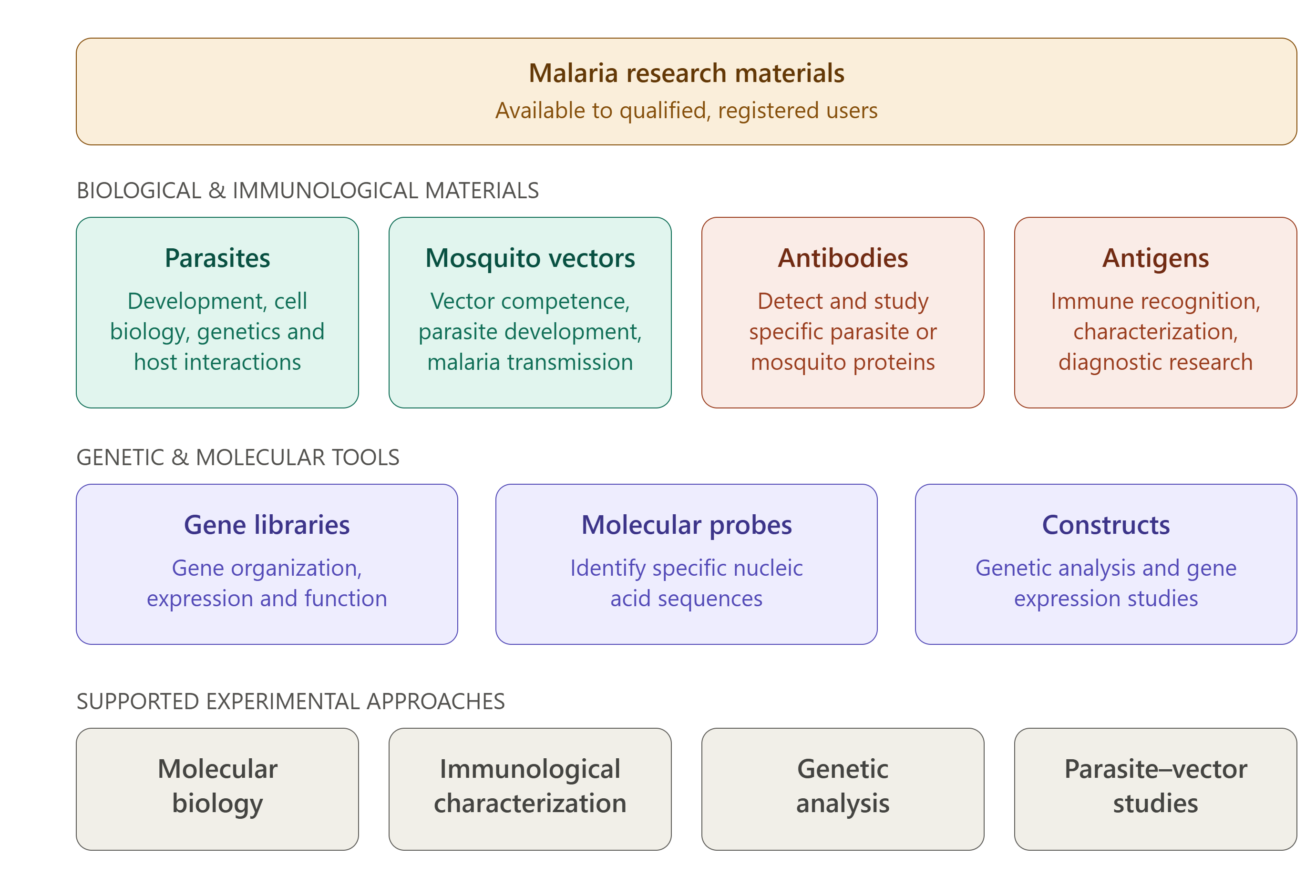
2. Malaria Research Materials Available to Qualified Users
3. Registration, Deposit and Order Forms
The complete set of registration, deposit and order forms is available HERE for downloading as Microsoft Word (.DOC) and Adobe Acrobat (.PDF) files.
These documents provide the administrative information and procedures required to access the resources made available through MR4.
The registration process allows users to establish their eligibility, while deposit forms support the documentation of materials contributed to the resource. Order forms provide a structured way for qualified users to request the research materials they need.
Providing these documents in both Microsoft Word and Adobe Acrobat formats makes them accessible to researchers who may need to complete, review or print the relevant forms.
4. Searching the MR4 Database and Accessing Vector Resources
See either our Search Database or the CDC Vector program for materials available to qualified, registered users.
The Search Database provides a way to explore available malaria-related research materials and identify resources relevant to specific scientific investigations.
The CDC Vector program offers an additional reference point for mosquito-related resources and vector research. These resources are particularly relevant to studies investigating mosquito biology, vector populations and the mechanisms involved in malaria transmission.
Together, these access points help researchers identify materials that may support their experimental requirements and scientific objectives.
5. NIAID Malaria Research Activities
An overview of other NIAID malaria research activities can be found on the NIAID Home Page.
The National Institute of Allergy and Infectious Diseases (NIAID) supports research addressing infectious diseases, immune responses and different aspects of malaria biology.
Access to information about NIAID malaria research activities provides additional scientific context for researchers interested in understanding broader research priorities, ongoing investigations and resources available to the malaria research community.
The connection between specialized reagent resources and wider research programs contributes to a collaborative environment in which scientific materials, data and knowledge can support complementary research activities.
6. Collaboration with the Multilateral Initiative on Malaria (MIM)
MR4 is an allied member of MIM, the Multilateral Initiative on Malaria.
The Multilateral Initiative on Malaria is associated with collaborative efforts to strengthen malaria research and encourage scientific cooperation among researchers and institutions working on malaria-related challenges.
Through its relationship with MIM, MR4 is connected to a wider scientific community focused on improving knowledge of malaria parasites, disease transmission and research approaches.
International collaboration is particularly important in malaria research because the disease involves complex biological and epidemiological processes that vary across geographical regions.

7. Database and Reagent Links with PlasmoDB and Malaria Parasite Metabolic Pathways
MR4 maintains database and reagent links with PlasmoDB and the Malaria Parasite Metabolic Pathways.
These connections provide additional resources for researchers investigating the genetic, molecular and metabolic characteristics of malaria parasites.
PlasmoDB is a specialized database dedicated to genomic and molecular information about Plasmodium species. It supports research involving parasite genomes, genes, proteins and biological processes.
The Malaria Parasite Metabolic Pathways resource provides information about metabolic processes in malaria parasites, helping researchers investigate the biochemical pathways required for parasite survival and development.
The integration of reagent resources with scientific databases is particularly valuable because experimental materials and molecular information can complement one another during research.
For example, researchers studying a specific parasite gene may use genomic databases to investigate its characteristics and molecular probes or antibodies to examine its expression or biological function.
8. MR4 and the International Malaria Research Community
MR4 contributes to the international malaria research environment by connecting biological resources, reference materials and scientific information.
Its collection of malaria-related materials supports investigations across multiple research disciplines, including parasitology, entomology, molecular biology, immunology and molecular diagnostics.
The availability of specialized reagents is particularly important for research involving Plasmodium parasites and mosquito vectors. These organisms are central to malaria transmission and require specific experimental materials for their biological characterization.
Through its database connections, institutional links and collaboration with malaria research organizations, MR4 forms part of a broader network supporting scientific investigations into malaria.
Researchers can also consult the links page on the left for additional MR4 and Malaria community affiliates, providing access to other organizations, databases and resources associated with malaria research.
Conclusion
The Malaria Research and Reference Reagent Resource Center (MR4) was established to provide a central source of quality-controlled malaria-related reagents and information to the international malaria research community.
By making parasites, mosquito vectors, antibodies, antigens, gene libraries, molecular probes and constructs available to qualified, registered users, MR4 supports a wide range of scientific investigations.
Its registration, deposit and order forms facilitate access to these materials, while the Search Database and CDC Vector program provide additional ways to identify available resources.
Furthermore, its connections with the Multilateral Initiative on Malaria (MIM), PlasmoDB and the Malaria Parasite Metabolic Pathways strengthen its links with the wider malaria research community.
Together, these resources contribute to scientific collaboration and support research into malaria parasite biology, mosquito vectors, molecular mechanisms and disease transmission.