
A Rapid, Simple Stain for Malaria Parasite Detection in Blood Films
Fields Stain Kit, 200 Tests (Ref. RRSK25-200): A Rapid, Simple Stain for Malaria Parasite Detection in Blood Films
Introduction
Malaria is still one of the most serious infectious diseases in the world, and microscopic examination of a stained blood film remains a cornerstone of its diagnosis. It is a method that is low-cost, direct, and available in laboratories of almost any size. But it depends on one thing above all: a good stain, applied quickly and consistently.
The Fields Stain Kit (Ref. RRSK25-200) from Atom Scientific is designed for this purpose. Packed under the tagline “Simplicity for Science,” the kit contains what a laboratory needs to stain 200 tests. This article covers what the kit is, how Fields stain works, what is included, and why it remains valued in parasitology.
What Is Fields Stain?
Fields stain is a rapid Romanowsky-type stain developed for the quick examination of blood films. According to the kit’s instructions, it is used for the detection of malarial parasites in blood films. The instructions also note that, with some modifications, it can be used for other purposes where eosin-based staining is needed.
Compared with Giemsa staining, which is often considered the reference method but takes longer, Fields stain is prized for speed. Because it works in a matter of minutes, it is especially useful when a rapid result is needed, such as in busy clinics, field settings, and emergency situations.
Product Overview
| Specification | Detail |
|---|---|
| Reference | RRSK25-200 |
| Product Name | Fields Stain Kit (Royal Society formulation, as shown on the instructions) |
| Number of Tests | 200 |
| Manufacturer | Atom Scientific |
| Components | Fields Stain Solution A, Fields Stain Solution B, and a third bottle (see the kit’s instructions) |
| Intended Use | Laboratory use (the instructions carry a use restriction notice) |
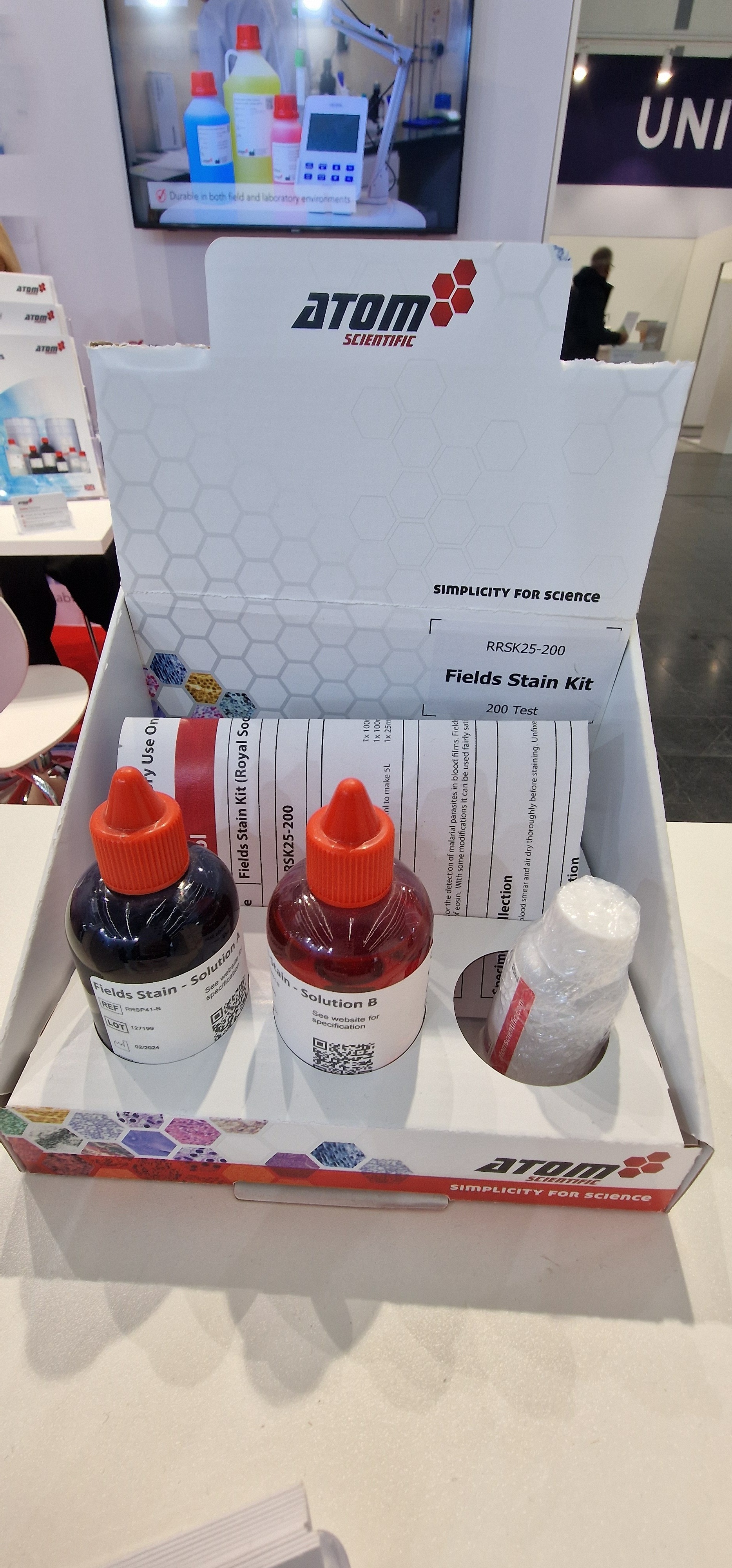
The box shows two stain bottles with orange dropper caps, labeled Solution A and Solution B, each with a reference number, lot number, and QR code. The label directs users to the manufacturer’s website for full specifications. A third bottle is packed in the kit and is shown wrapped in protective film.
How Does a Two-Solution Fields Stain Work?
Romanowsky stains combine a basic dye (such as methylene blue and its derivatives) and an acidic dye (eosin). Each colors different parts of the cell:
- Solution A is typically the blue-purple component, which stains nuclear material and parasite chromatin.
- Solution B is typically the red-pink component, which provides the eosin counterstain for cytoplasm and red blood cells.
In a malaria film, the parasite’s chromatin appears red to purple, its cytoplasm blue, and the surrounding red blood cells pink. This color contrast allows the microscopist to identify the parasite and to examine features such as stage and species.
For the exact function of each solution and the precise protocol, please follow the instructions that come with the kit.
Key Advantages
1. Speed. Fields stain is known as a rapid method, so results can be reached much faster than with many traditional staining protocols.
2. Simplicity. A few steps, minimal equipment, and a ready-to-use format make the kit easy to adopt, even for laboratories with limited resources.
3. Practicality for field and routine settings. The kit is compact, and the packaging fits a benchtop or a mobile setup.
4. Convenient quantity. With 200 tests per kit, it suits routine workloads without requiring bulk purchasing.
5. Traceability. Each bottle carries a reference number, lot number, and a QR code that links to specifications, which supports quality documentation.
Applications
Malaria Diagnosis
The main use is detecting malaria parasites (Plasmodium species) in thin and thick blood films. Thick films are valued for their sensitivity, since they concentrate the parasites, while thin films help identify the species and parasite stage.
Teaching and Training
Parasitology courses use rapid stains like this one to teach students how to prepare, stain, and interpret blood films.
Quality Control and Proficiency Testing
Laboratories that maintain microscopy skills for malaria can use a standard stain kit to keep their processes consistent.
Other Staining Needs
The kit instructions mention that, with modifications, the stain can also serve other eosin-based staining purposes. Laboratories that wish to adapt it should validate their own protocol.
General Workflow
The instructions mention that the specimen should be fixed or the blood smear should be air-dried thoroughly before staining. A typical Fields stain procedure follows this outline:
- Prepare the blood film on a clean glass slide.
- Air-dry it thoroughly. The instructions stress this step.
- Apply the stain solutions in the order and for the times given in the kit instructions.
- Rinse gently with buffered or clean water as directed.
- Dry the slide and examine it under the microscope, usually with an oil immersion objective.
Exact timings and volumes should always be taken from the kit’s instruction leaflet, since they depend on the formulation.
Storage, Handling, and Safety
- Follow the storage instructions in the leaflet and on the website specification. The label does not state a temperature in the photo.
- Keep bottles tightly closed after use to limit evaporation and contamination.
- Check the lot number and date on each bottle, and record them in your lab notebook.
- Wear gloves, a lab coat, and eye protection. Stain solutions can contain solvents and dyes that stain skin and clothing.
- Handle blood samples as potentially infectious, following your institution’s biosafety rules.
- Dispose of used stain and slides according to local regulations.
Why Choose a Kit Format?
Buying stain solutions separately can create variation, because users must find compatible reagents and make sure they are consistent. A kit offers several benefits:
- Everything needed is in one box, matched for use together
- Reduced preparation errors
- Clear instructions and traceability
- Easier ordering and inventory management
About Atom Scientific
Atom Scientific is a supplier of laboratory chemicals and reagents, including histology and microbiology stains and related products. Its brand message, “Simplicity for Science,” reflects a focus on making laboratory work easier and more reliable. Its materials, as seen in the displays around the product, highlight reagents that are durable in both field and laboratory environments.
Frequently Asked Questions
What is the Fields Stain Kit used for?
According to the instructions, it is used for the detection of malarial parasites in blood films.
How many tests does one kit provide?
The box states 200 tests.
What do Solutions A and B do?
They are the two components of the stain. See the instruction leaflet for the exact role of each and the staining sequence.
Can it be used for tests other than malaria?
The leaflet indicates that, with some modifications, it can be used for other purposes. Validate any modified protocol in your own laboratory.
Where can I find the full specifications?
The bottle labels refer users to the manufacturer’s website, and a QR code is provided on each bottle.
Does it replace Giemsa staining?
They are different methods. Fields stain is valued for speed, while Giemsa is often preferred for detailed morphology. Choose according to your laboratory’s needs and local guidelines.
Conclusion
The Fields Stain Kit (Ref. RRSK25-200) from Atom Scientific gives laboratories a quick, simple, and well-organized way to stain blood films for malaria detection. With 200 tests per box, clear labeling with lot numbers and QR codes, and a straightforward two-solution system, it fits routine diagnostic work, training, and field use.