
Blog
Global Co-Transmission of paludism and Lymphatic Filariasis by Mosquito Vectors
Introduction
Vector-borne diseases continue to represent a critical global health concern. Among approximately 4,000 identified mosquito species, fewer than 10% function as efficient vectors of human pathogens. Two of the most impactful parasitic infections transmitted by mosquitoes are paludism and lymphatic filariasis (LF).
These diseases are widely distributed across tropical and subtropical regions and frequently involve shared mosquito vectors, particularly Anopheles species. Their wid
…
31st Mar 2026
Genome of Anopheles gambiae: What We Know Today
Genome of Anopheles gambiae: What We Know Today
Mosquitoes are among the most dangerous animals on Earth not because of their bite itself, but because of the pathogens they transmit. Among them, Anopheles gambiae stands out as one of the most efficient vectors of malaria, responsible for a significant proportion of cases in sub-Saharan Africa. Its success as a vector is not accidental it is deeply rooted in its genetic makeup. Over the past two decades, genomic research has transformed our under
…
24th Mar 2026
Analysis of Mosquito Immune Responses
Understanding Mosquito Defense Systems Against Pathogens
Introduction
Mosquitoes host complex microbial communities and interact with numerous microorganisms in their natural environments. Understanding how mosquitoes respond to microbial exposure at the molecular level has become a major focus in modern molecular biology and vector research. One of the most powerful approaches used to investigate these biological mechanisms is transcriptomic analysis, which allows researchers to examine global
…
24th Mar 2026
CRISPR in Mosquito Control: Future or Risk?
CRISPR in Mosquito Control: Future or Risk?
Mosquitoes are more than just annoying summertime pests they are vectors for deadly diseases like malaria, dengue, Zika, and yellow fever. Traditional control methods, including insecticides and bed nets, have saved millions of lives, but mosquitoes are evolving resistance, and new solutions are needed. One of the most exciting and controversial approaches is CRISPR-based gene editing. But is this the future of mosquito control, or a risky experiment w
…
24th Mar 2026
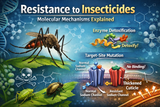
Resistance to Insecticides: Molecular Mechanisms Explained
Resistance to Insecticides: Molecular Mechanisms Explained
Insecticides have been one of humanity’s most important tools in fighting insect-borne diseases and protecting crops. From mosquitoes that spread malaria and dengue to pests that damage food supplies, chemical control has saved countless lives and livelihoods. But over time, many insects have developed resistance, making these chemicals less effective. Understanding how this resistance works at the molecular level is key for scient
…
24th Mar 2026